
Bank Reconciliation Problems in E-Commerce Businesses
E-commerce looks simple. Orders come in. Customers pay. Money reaches the bank.
However, from an accounting perspective, things are rarely that clean.
Most online sellers struggle with e-commerce bank reconciliation problems because sales reports, payment gateways, COD collections, and bank deposits never align perfectly.
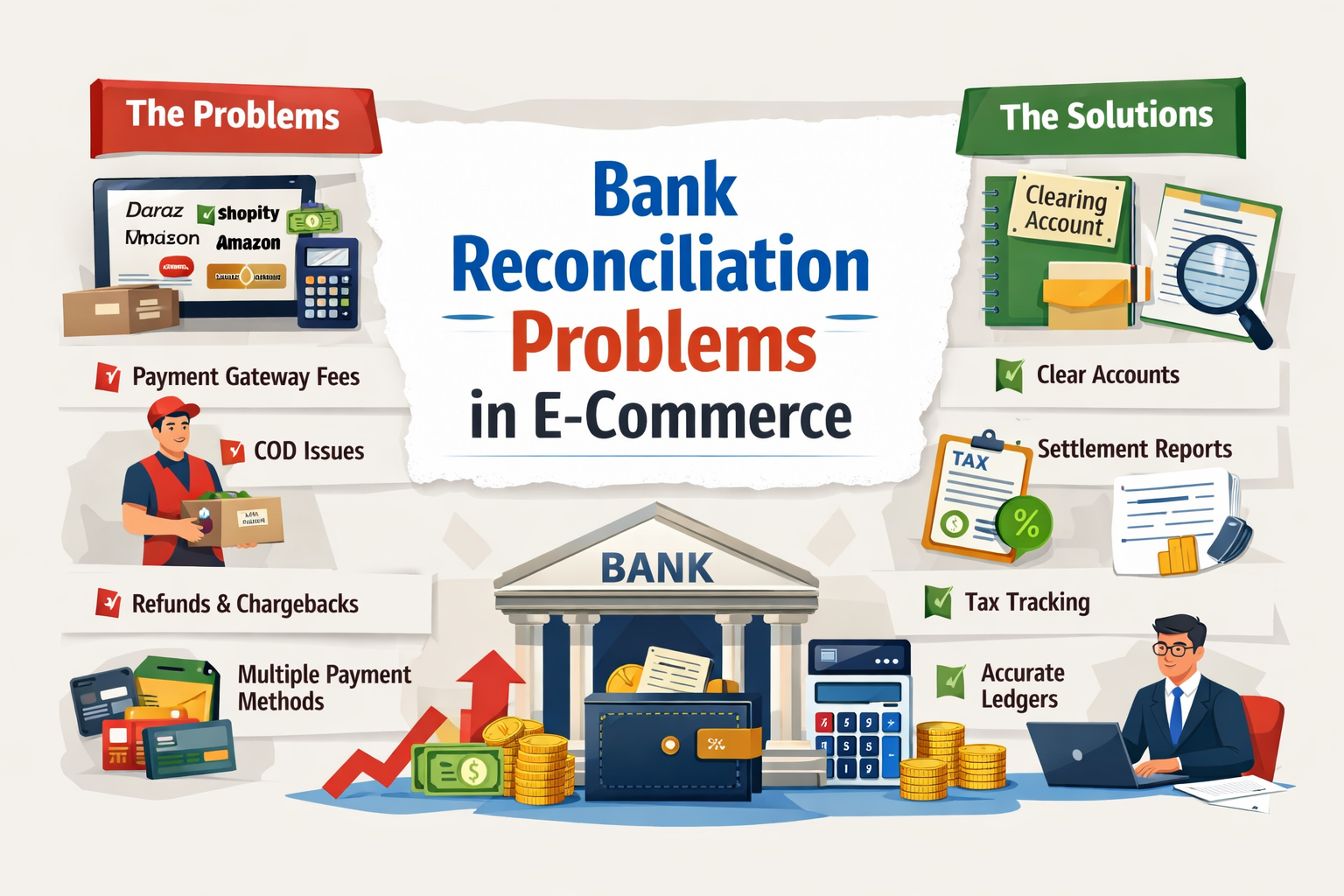
If you run an online store, this article will help you understand the accounting side of these issues.
1-Gross Sales vs Net Settlement Problem
If you sell through Shopify, WooCommerce, or Daraz, your system shows gross sales.
But your bank receives net settlement.
For example:
- Gross sales: Rs. 500,000
- Commission: Rs. 20,000
- Payment gateway fee: Rs. 8,000
- Withholding tax: Rs. 9,700
- Net bank deposit: Rs. 462,300
From an accounting standpoint, recording only Rs. 462,300 as sales is incorrect.
Correct Accounting Entry:
At time of sale:
Dr Payment Gateway Receivable 500,000
Cr Sales Revenue 500,000
At settlement:
Dr Bank 462,300
Dr Commission Expense 20,000
Dr Gateway Charges 8,000
Dr Withholding Tax Receivable 9,700
Cr Payment Gateway Receivable 500,000
This structure keeps revenue accurate and expenses transparent.
2-Timing Differences and Accrual Issues
Gateways like PayFast and PayPro settle funds after several days.
Therefore:
- Sale recorded in June
- Cash received in July
If you follow accrual accounting (which you should), revenue belongs to June. But bank reconciliation belongs to July.
This creates a classic timing difference.
Without a clearing account, your trial balance and bank statement will never agree.
3-Cash on Delivery (COD) Control Weakness
COD is dominant in Pakistan.
Courier companies collect cash and then deduct:
- Delivery charges
- Return charges
- Handling fees
After that, they deposit net amounts weekly.
Accounting issue?
Most businesses directly record bank deposit as sales. This creates:
- Understated revenue
- Untracked returns
- Missing parcel risk
Instead, use a COD Receivable Control Account.
When order is dispatched:
Dr COD Receivable
Cr Sales
When courier settles:
Dr Bank
Dr Delivery Expense
Cr COD Receivable
This method protects your revenue integrity.
4- Refunds and Revenue Recognition Errors
Refunds complicate revenue recognition.
E-commerce businesses often:
- Adjust refunds directly against current sales
- Ignore chargeback fees
- Forget prior period impact
However, accounting standards require proper matching.
Refund entry should be:
Dr Sales Returns
Cr Payment Gateway / Bank
And if a chargeback fee applies:
Dr Bank Charges Expense
Cr Bank
Separating Sales Returns from Sales Revenue gives a clearer gross margin picture.
5- Withholding Tax Deduction Confusion
Marketplaces like Daraz deduct withholding tax before settlement.
Many sellers treat this as expense.
That is wrong.
It is an advance adjustable tax, not an expense.
Correct entry:
Dr Withholding Tax Receivable
Cr Payment Gateway Receivable
Later, you adjust it while filing with the Federal Board of Revenue.
If you fail to track this properly, annual tax reconciliation becomes stressful.
You can cross-check tax impact using structured tools like:
https://muhasibandco.com/income-tax-calculator/
6- High Volume and Internal Control Risks
E-commerce businesses process hundreds of daily transactions.
This increases risk of:
- Duplicate posting
- Missing entries
- Fake refunds
- Manipulated discounts
From an internal control perspective:
- Reconcile settlement-wise, not order-wise
- Lock accounting periods monthly
- Separate refund approval from accounting posting
- Match gateway report with bank statement, not just store dashboard
7- Foreign Currency & Exchange Gain/Loss
If you receive international payments, currency differences arise.
For example:
- Sale recorded at booking rate
- Settlement converted at different rate
Accounting treatment:
Dr Bank (actual received)
Cr Payment Gateway Receivable (booking rate)
Dr/Cr Exchange Gain or Loss (difference)
If you ignore exchange variance, reconciliation gaps will remain unexplained.
The Core Accounting Mistake in E-Commerce
Most small online businesses make one structural mistake:
They post everything directly to the bank account.
No clearing account.
No receivable control.
No settlement tracking.
As a result:
- Revenue gets distorted
- Expenses get mixed
- Tax position becomes unclear
- Bank reconciliation consumes hours
Professional Structure for Clean Reconciliation
To eliminate e-commerce bank reconciliation problems:
- Create separate gateway receivable accounts
- Use COD control ledger
- Record gross sales, not net deposits
- Track withholding tax separately
- Reconcile settlement report before bank matching
If you want professional help structuring your accounting system, explore our bookkeeping solutions at:
https://muhasibandco.com/our-services/
Final Thoughts
E-commerce accounting demands more control than traditional trading.
If your reconciliation feels messy, the issue is not the bank statement. The issue is ledger design.
Once you structure your chart of accounts correctly, reconciliation becomes mechanical instead of stressful.
And when reconciliation becomes clean, your profit numbers finally become reliable.